
Hiring a garage door subcontractor is not automatically a scam, but it can turn into one fast. Subcontracting itself is a normal, legal practice across garage door repair services and the wider industry. The scam risk comes from a lack of transparency: no license or insurance on file, no scope of work in writing, and no way to confirm who actually shows up at your home. If a company will not answer straightforward questions about licensing, contracts, or the crew doing the installation, treat that as your signal to slow down and verify before you pay anything.
Key Takeaways
- Subcontracting is common and legal in the garage door industry. The red flag is hidden information, not subcontracting itself.
- Always confirm the installer’s license and insurance before work begins, no matter whose name is on the invoice.
- A written contract with a defined scope of work protects you and the company if something goes wrong.
- Cash-only demands and unusually large upfront deposits are among the clearest signs of a problem crew.
- Ask directly who will be on-site, and get that answer in writing before the appointment, not after.
- A legitimate company will never penalize you for asking these questions upfront.
Legitimate Subcontracting vs. Red-Flag Behavior
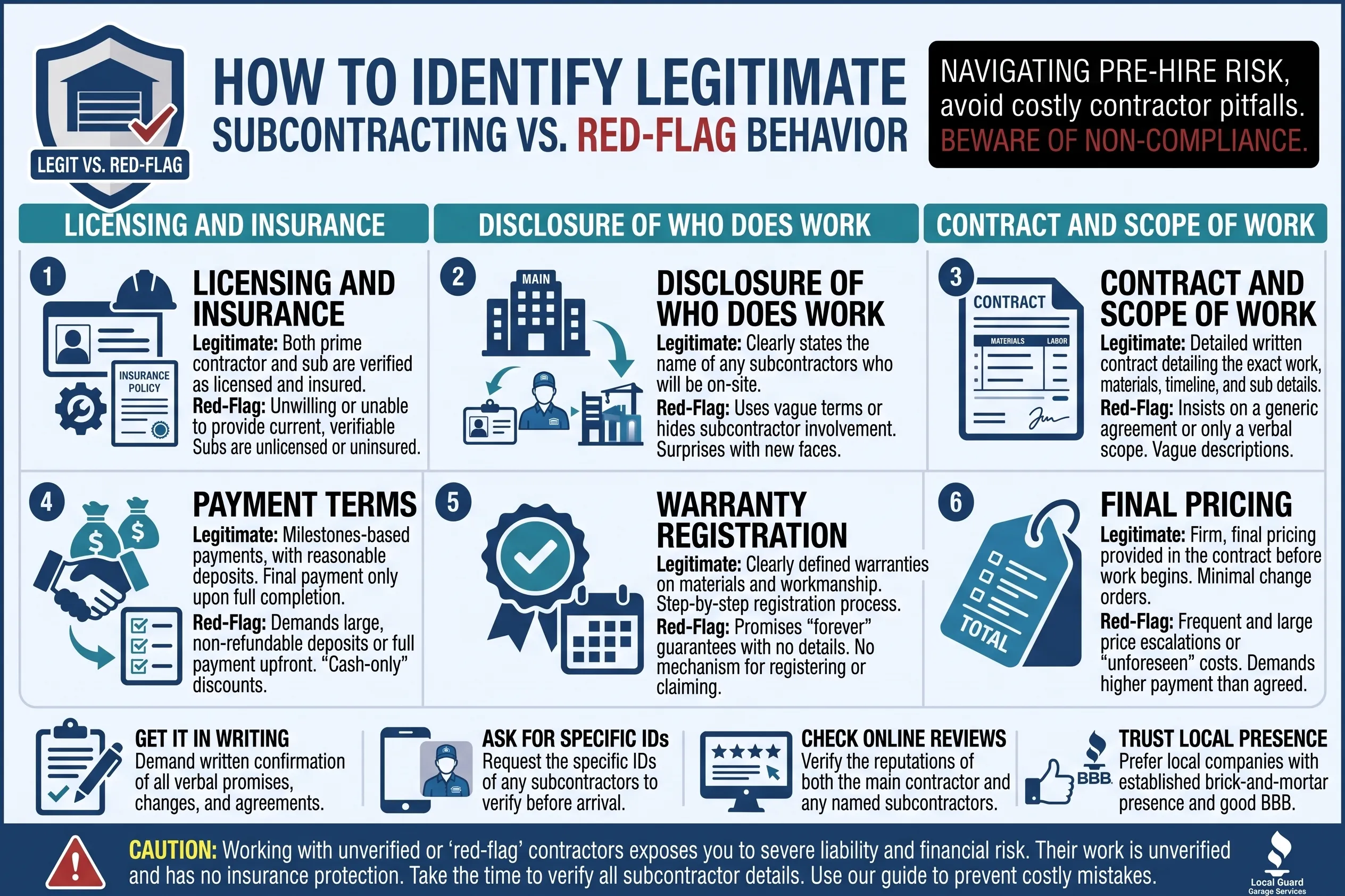
What to Check | Legitimate Practice | Red-Flag Behavior |
Licensing and insurance | Provided on request, verifiable with the state board | Withheld, delayed, or inconsistent answers |
Disclosure of who does the work | Company tells you directly whether a subcontractor is used | Vague, avoided, or denied when asked |
Contract and scope of work | Written estimate listing model, hardware, price, and timeline | Verbal agreement only, or vague written terms |
Payment terms | Modest deposit, balance due after inspection, multiple payment methods accepted | Cash-only demands, full payment upfront |
Warranty registration | Installer confirms manufacturer warranty registration in writing | No documentation, or warranty later denied |
Final pricing | Matches the written estimate, with clearly explained exceptions | Price increases on-site without a specific reason |
1. They Never Mention Licensing or Insurance
How to Verify a Garage Door Installer’s License and Insurance
The most common version of this problem starts before a single tool comes out of the truck. A company quotes a price, books an appointment, and never once brings up licensing or insurance unless the homeowner asks directly.
This usually happens for one of two reasons: the crew showing up is not actually licensed or insured for the work, or the company that sold the job does not actually know who its subcontractor is either. Neither answer should sit well with you.
Before you schedule the appointment, verify the following:
- Ask for the installer’s license number and a current certificate of insurance.
- Check that license number against your state’s contractor licensing board.
- Confirm the insurance certificate lists an active policy, not an expired one.
A legitimate operation can produce all three within minutes, not days.
Walk away if the company cannot produce a license number or insurance certificate on request, or if the answer changes depending on who you ask.
If you want a full walkthrough of how to verify a garage door installer’s license and insurance, read How Do I Know If My Garage Door Installer Is Licensed and Insured? 5 Ways to Check.
2. There’s No Written Contract or Scope of Work
Why a Written Garage Door Installation Contract Protects You
Some companies operate entirely on verbal agreements: a price over the phone, a handshake at the door, and no paperwork defining what work is actually being done. That absence of a contract is one of the fastest ways a straightforward job turns into a dispute.
Without a written scope of work, there is nothing spelling out the door model, opener, hardware, timeline, warranty terms, or what happens if something is damaged during installation. If a disagreement comes up later, you are left with someone’s memory of a phone call instead of a document.
Before any work begins, get a written estimate that lists the specific door and opener model, the hardware included, the labor covered, the total price, and the payment schedule. Read it before you sign, and keep a copy.
Walk away if a company refuses to put the job in writing, or if the written estimate is vague about the door model, hardware, or price.
If you want to see the specific signs that a subcontractor is skipping a written contract, read Why Did My Garage Door Subcontractor Skip a Written Contract? 5 Warning Signs to Watch For.
3. They Won’t Say Who Is Actually Installing Your Door
How to Find Out If a Garage Door Subcontractor Is Doing the Work
Subcontracting is normal on its own. The problem is when the company hides who is actually doing the work instead of disclosing it, and the question gets brushed off when you ask.
Ask directly whether the technician is a direct employee or a subcontractor, and get their name and license information ahead of the appointment.
Walk away if the company dodges the question, or if the person who shows up cannot confirm who they work for.
If you suspect your installer isn’t disclosing who’s doing the work, read Why Won’t My Garage Door Company Say Who’s Actually Installing My Door? 4 Signs of Undisclosed Subcontracting.
4. They Push for Cash-Only Payment or a Large Upfront Deposit
Why Cash-Only Payment Requests Are a Garage Door Contractor Warning Sign
A quote comes in, and the company insists on cash only, or asks for the full balance, or close to it, before any work has started. This is one of the most commonly reported red flags among homeowners vetting contractors of any kind, not just garage door installers.
Cash-only demands make it harder to dispute the charge later and harder to prove what was actually paid for. Large upfront deposits shift all the financial risk onto you before any work is verified.
A reasonable deposit structure ties payment to progress. Before you agree to anything, check for the following:
- A modest deposit to schedule the job, not the full balance upfront.
- The remaining balance due only after the work is inspected and completed.
- More than one accepted payment method, not cash only.
- The deposit amount written into the estimate, not just quoted verbally.
Walk away if a company demands cash only, refuses any other payment method, or asks for the full price upfront.
5. The Company Has No Verifiable Local Address or Track Record
How to Check a Garage Door Company’s Local Reputation Before Hiring
Something feels off, but you cannot quite name it. Often it comes down to this: the company has no verifiable physical address, no consistent phone number across its listings, or a review history that appeared suddenly with little history behind it.
This pattern is common with companies that operate under multiple names, or that rebrand after accumulating complaints. It is easy to miss when you are focused on price alone.
Before hiring, take a few minutes to check the following:
- The business name, address, and phone number, searched together.
- The Better Business Bureau listing for complaints or an unresolved pattern.
- The Google Business Profile and Yelp history for consistency across platforms.
- Whether the reviews span a real history, not just a handful posted in the same week.
Walk away if the address does not check out, if the phone number changes between platforms, or if the review history looks manufactured.
6. Your Manufacturer Warranty Isn’t Honored or Gets Voided
How Subcontractor Work Can Affect Your Garage Door Warranty
A warranty claim gets denied because the installation was never properly documented. Manufacturer warranties often require records showing who did the work and when, and off-the-books subcontracting means that paperwork simply does not exist.
Before installation, confirm the installer can register the warranty with the manufacturer and will provide documentation of the installation date and model numbers.
Walk away if the company cannot confirm warranty registration, or if it tells you the warranty is “not really enforced anyway.”
7. The Price Changes Once the Crew Shows Up
How to Avoid Garage Door Installation Bait-and-Switch Pricing
The quoted price climbs once the crew arrives, with an added charge for hardware, disposal, or “unexpected complications” never mentioned in the estimate. This usually means the original quote was intentionally low to win the job.
Get a detailed, itemized estimate in writing, and ask what circumstances could change the price. A legitimate company names specific, verifiable scenarios, not vague catch-all language.
Walk away if the price jumps significantly on-site without a specific, verifiable reason tied to something the crew found during the work.
What the Industry Is Saying
Garage door scams are not a fringe concern raised by a handful of unhappy customers. The International Door Association (IDA), the trade association representing the door and access system industry, actively tracks fraud reports from across the country and directs both homeowners and member businesses to verify credentials and avoid upfront payment before any work begins. For more on how widespread this issue has become, see the IDA’s official scam awareness resources and its industry post covering the same concern.
Silence Is the Scam, Not the Subcontractor
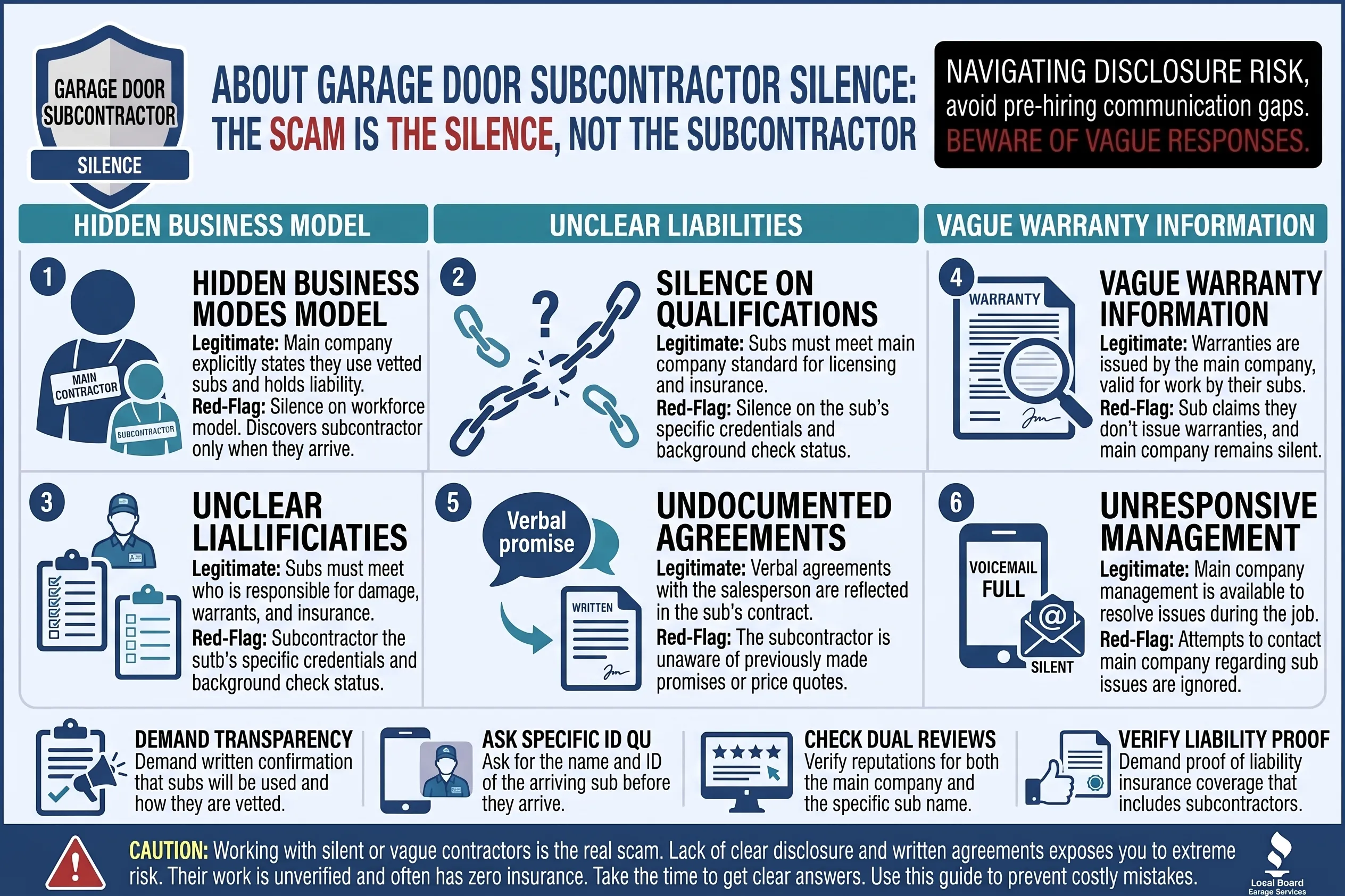
Subcontracting is not the problem. Silence is. A garage door company that discloses who is doing the work, puts the job in writing, and stands behind its pricing and warranty is operating the way any legitimate contractor should, whether the crew is a direct employee or a vetted subcontractor.
Cleveland County Garage Doors provides direct, transparent residential garage door installation and repair across Cleveland County, with dedicated support for Shelby and Kings Mountain homeowners, and clear answers to exactly these kinds of questions before any work begins. Contact us or give us a call to get a free quote and ask us anything on this list. We expect the questions.