
Whether you’re hiring for garage door repair services or a full replacement, a garage door subcontractor skipping a written contract is one of the clearest warning signs of a problem job, even when the price and the crew seem fine. Watch for five signs: no written estimate at all, a scope of work that’s vague about materials or models, no payment schedule or timeline in writing, a request to sign something blank or incomplete, and any discouragement from keeping your own copy of the agreement. None of these signs prove a scam by themselves, but together they mean you have no documentation to fall back on if something goes wrong. Get it in writing before any work begins.
Key Takeaways
- A written estimate should exist before any work begins, not after.
- The scope of work should name the specific door and opener model, not just “a new door.”
- Payment terms and a rough timeline belong in writing, not just in conversation.
- Never sign anything with blank sections left to be filled in later.
- You have the right to keep a copy of every document you sign.
- A legitimate company will never pressure you to skip any of this.
What Belongs in Writing vs. What’s Missing Without a Contract
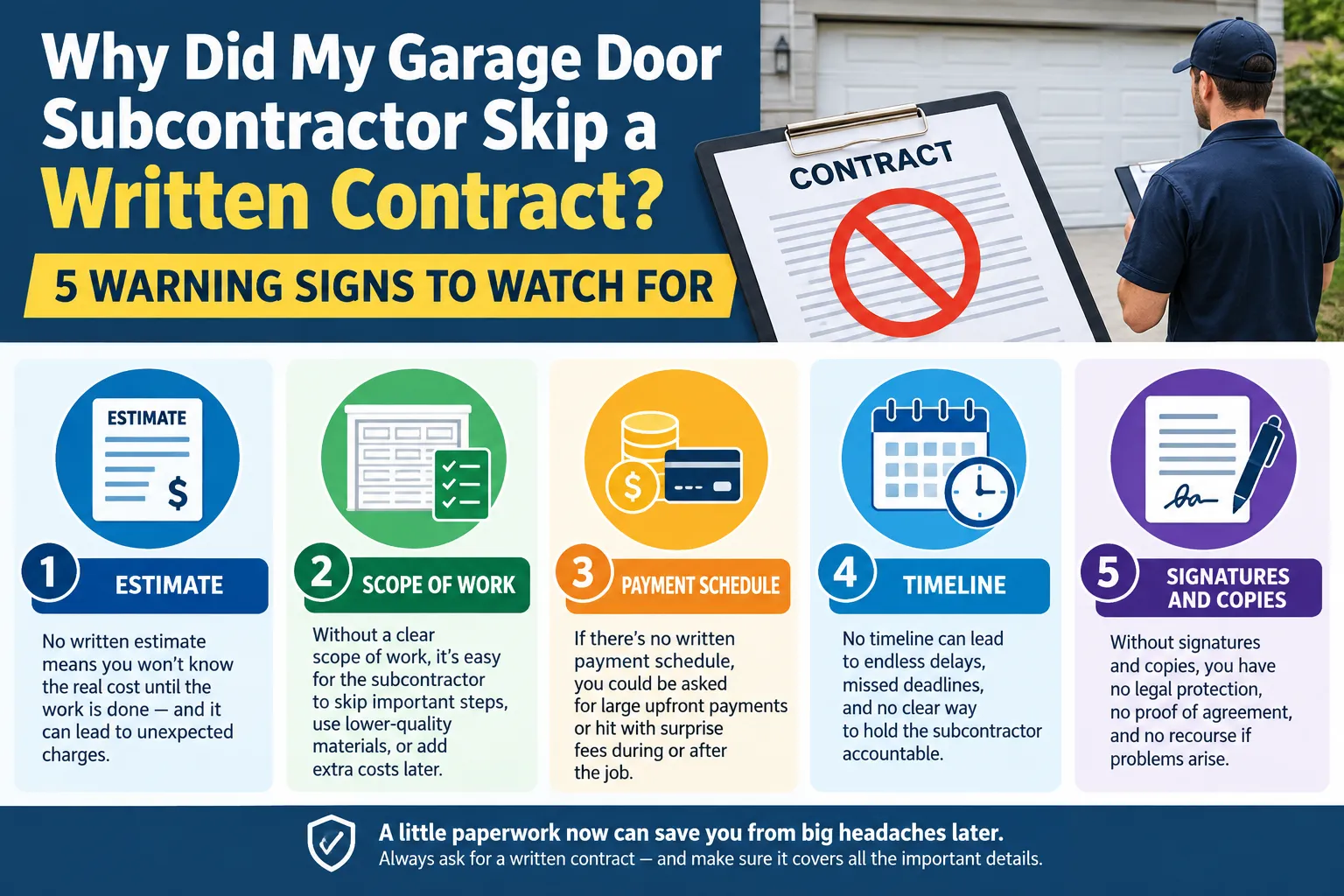
Contract Element | What It Should Include | What’s Missing Without It |
Estimate | Total price, itemized where possible | No record of what was actually agreed to |
Scope of work | Door and opener model, hardware, labor covered | No way to confirm what was promised versus delivered |
Payment schedule | Deposit amount, balance due, accepted methods | No protection if payment terms shift later |
Timeline | Start date, estimated completion | No accountability if the job drags on |
Signatures and copies | Both parties sign, homeowner keeps a copy | No proof of the agreement if a dispute comes up |
1. They Quote a Price But Never Send Anything in Writing
How to Get a Garage Door Estimate in Writing Before You Agree
A number gets mentioned over the phone or at the door, and that’s the last you hear about pricing until the invoice. No estimate ever shows up in an email, text, or paper form.
Before you agree to anything, ask for:
- A written estimate sent by email or text, not just spoken.
- The total price, broken down by labor and materials where possible.
- A copy you can keep, not just something shown to you once.
A written estimate takes a company only a few minutes to send, so a repeated delay usually means it isn’t a priority for them, and it shouldn’t be optional for you either. If the price only exists as something someone said out loud, you have nothing to hold anyone to later.
Walk away if the company won’t send a written estimate before scheduling the work.
If you want the full picture, read Is Hiring a Garage Door Subcontractor a Scam or Not.
2. The Scope of Work Isn’t Specific About Materials or Models
Why a Vague Garage Door Estimate Is a Warning Sign
The estimate exists, but it says something like “new garage door” or “opener replacement” with no model numbers, materials, or hardware specified. That vagueness leaves room for a downgrade you won’t notice until it’s already installed.
A proper scope of work should specify:
- The exact door model, material, and insulation level.
- The opener model and any accessories included, like keypads or remotes.
- Whether old hardware is being replaced or reused.
Specificity here isn’t a formality. It’s what lets you compare the estimate against what actually shows up on installation day.
Walk away if the estimate is too vague to compare against what actually gets installed.
If you want to confirm the installer behind this estimate is who they say they are, read How Do I Know If My Garage Door Installer Is Licensed and Insured? 5 Ways to Check.
3. There’s No Payment Schedule or Timeline Written Down
How to Set a Garage Door Payment Schedule Before Work Begins
You know the total price, but nothing spells out when payments are due or how long the job should take. Without that structure, the payment terms can shift once work is already underway.
Confirm in writing:
- The deposit amount, if any, and when it’s due.
- The balance due date, tied to a stage of completion, not just “when it’s done.”
- A rough start date and expected completion window.
A timeline doesn’t need to be exact to the day, but it should give you something concrete to hold the company to if the job runs long. Vague timeframes like “sometime this month” leave you with no real way to know if a delay is normal or a sign the job has stalled.
Walk away if the company won’t commit to payment terms or a timeline in writing.
4. They Ask You to Sign Something Blank or Incomplete
Why You Should Never Sign a Blank Garage Door Contract
A document gets placed in front of you with sections left blank, to be “filled in later.” Maybe it’s the price, maybe it’s the model number, maybe it’s the date. Whatever it is, an incomplete document protects the company, not you.
Before signing anything, confirm:
- Every field is filled in, with no blank spaces left for later.
- The price, scope, and date match what you were actually told.
- You get a copy of the exact document you signed, not a different version afterward.
There is no legitimate reason to leave key terms blank on a document you’re about to sign. If it isn’t ready to be complete, it isn’t ready to be signed.
Walk away if you’re asked to sign anything with blank fields, even if you’re told it’s just a formality.
If you also want to confirm who’s actually doing the work before you sign anything, read Why Won’t My Garage Door Company Say Who’s Actually Installing My Door? 4 Signs of Undisclosed Subcontracting.
5. They Discourage You From Keeping a Copy of the Agreement
Why You Should Always Keep a Copy of Your Garage Door Contract
You ask for a copy of what you signed, and the company hesitates, says it’s not necessary, or promises to email it later and never does. A legitimate company has no reason to keep you from having your own paperwork.
Insist on:
- A copy at the time of signing, on paper or by email, not “later.”
- The same document you actually signed, not a summary or a different version.
- Confirmation that the copy includes every page, not just the signature page.
Keep this copy with your other home improvement records. It’s the first thing you’ll want if a dispute ever comes up, and the easiest thing to lose track of if you don’t ask for it upfront.
Walk away if a company won’t let you leave with a copy of what you signed.
If you want a broader look at what a properly executed installation should include, read How to Tell If Your Garage Door Installation Was Done Correctly.
What the Industry Is Saying
Skipping a written contract isn’t a minor inconvenience. It’s a pattern the International Door Association (IDA) actively flags as part of its industry-wide scam awareness work, alongside upfront cash demands and unclear pricing. The IDA encourages homeowners to get agreements in writing and to report businesses that avoid documentation altogether. See the IDA’s scam awareness resources and its industry post covering the same concern for more.
If It’s Not Written Down, It’s Not Agreed To
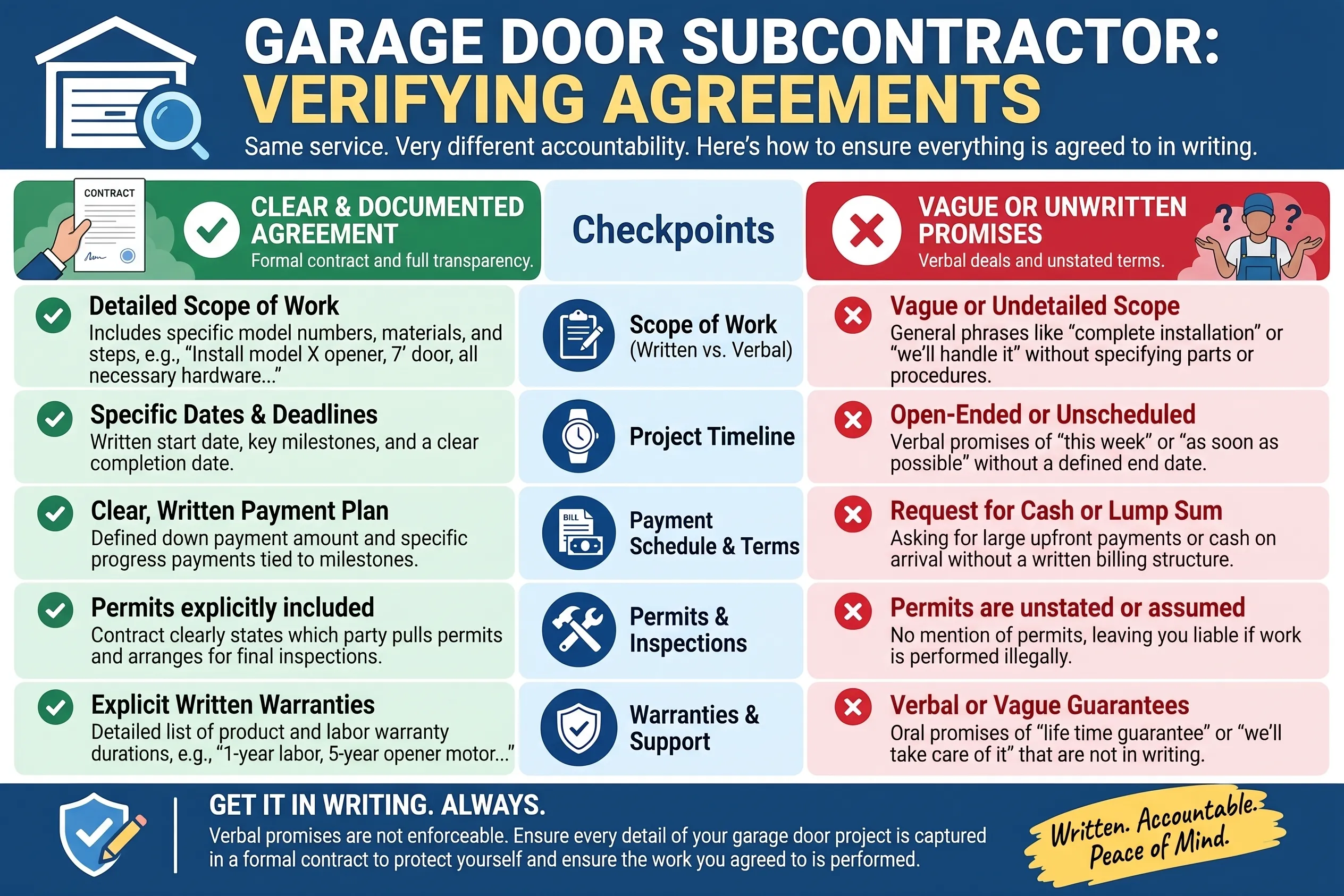
A verbal price and a handshake might feel like enough in the moment, but they leave you with nothing to point to if the job goes sideways. A written estimate, a specific scope of work, a clear payment schedule, a complete document, and your own copy of all of it cost the company nothing to provide.
Cleveland County Garage Doors puts every estimate and agreement in writing for homeowners across Cleveland County, including Shelby and Kings Mountain, before any work begins. Contact us or give us a call to get a free quote, and you’ll have it in writing from the start.