
A garage door replacement is worth considering if your door is 15 to 30 years old, needs a repair call more than once or twice a year, has visible damage to panels or the frame, or is missing basic safety features like auto-reverse sensors. If the door is under 10 years old with one isolated problem (a broken spring, a bad sensor, a dented panel), a repair almost always makes more sense than garage door replacement.
Key Takeaways
- Most steel garage doors last 15 to 30 years with regular maintenance; wood doors often need replacement sooner.
- Frequent garage door service repair calls (more than once or twice a year) usually cost more over time than one replacement.
- Visible rust, warping, or cracked panels are structural issues, not cosmetic ones, and repair won’t fully fix them.
- A door that’s noisy, shaky, or slow to respond is telling you the whole system is wearing out, not just one part.
- Missing auto-reverse or rolling-code technology is a safety gap that repair can’t add to an older door.
- When in doubt, a technician can inspect the door in person and tell you honestly whether it’s a repair or a replacement.
Repair vs. Replace: Quick Comparison
Situation | Repair Usually Makes Sense | Replacement Usually Makes Sense |
Door age | Under 10 to 12 years | 15 to 30+ years |
Repair history | First issue in years | Second or third repair this year |
Damage type | Single broken part (spring, cable, sensor) | Warped panels, bent frame, rust-through |
Noise | Occasional squeak | Grinding, banging, visible shaking |
Operation | Recently slowed, otherwise normal history | Chronically slow, uneven, or hesitating |
Safety features | Auto-reverse works, rolling-code remote | No auto-reverse, fixed-code remote |
Insulation | Minor draft, seals worn | Single-layer steel or wood, no thermal break |
Appearance | Faded but structurally sound | Rust, warping, plus one or more signs above |
Your Door Is 15 to 30 Years Old
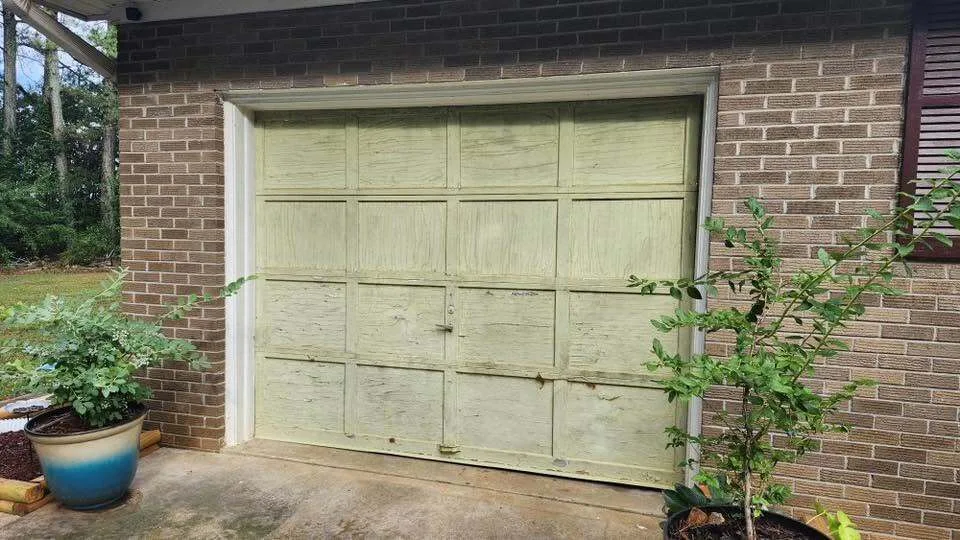
Age is the single biggest predictor of whether a garage door is nearing the end of its service life. Most steel doors are built to last 15 to 30 years with regular maintenance. Wood doors, and doors that have been through a lot of weather exposure without upkeep, often need replacement closer to the 10 to 15 year mark.
If you don’t know the exact install date, check the inside of the door near the bottom corner. Many manufacturers stamp a production date there. If your door is inside that 15 to 30 year window and starting to show other signs on this list, age is likely working against you rather than for you.
How to Tell If Your Garage Door’s Age Means It’s Time to Replace
Age alone isn’t always a reason to replace a door that’s otherwise working well. What matters is age combined with condition. A well-maintained 20-year-old steel door with no rust, no damage, and a quiet, smooth operation can often keep going for years. A 12-year-old door that’s already rusting, sagging, or needing repairs every few months is aging faster than its calendar age suggests, and that’s the one to plan a replacement for.
If you want a deeper breakdown of what actually determines a garage door’s lifespan, our guide on How Long Does a Garage Door Really Last? 5 Signs Your Door Is Past Its Prime walks through the factors that speed up or slow down aging.
Repairs Are Becoming Frequent and Costly
One of the clearest signals we see in the field is a homeowner who’s called for the second or third repair in the same year. A single repair, a broken spring, a worn cable, a bad opener sensor, is normal wear and tear. Multiple repairs in a short window usually means the underlying system (springs, rollers, tracks, opener) is wearing out together, and each new fix is a patch on a door that’s telling you it’s done.
How to Know When Repair Frequency Means You Should Replace Instead
A simple rule of thumb for weighing repair against replacement:
- One repair in years: normal wear and tear, repair it and move on
- Two or more separate repairs in the past 12 months: worth comparing running repair costs against the cost of a new door
- A technician flags a third likely issue soon: this is usually the tipping point toward replacement
- Each fix feels like a patch, not a solution: a sign the underlying system, not just one part, is wearing out
In our experience, this is the point where most homeowners are better off replacing than continuing to repair. For a closer look at exactly how many repair calls should raise a red flag, read our guide on How Many Repairs Are Too Many? 4 Signs Your Garage Door Is Beyond Fixing.
Visible Damage to Panels or the Frame
Cracked panels, warped sections, or a frame that’s bent or pulled away from the wall are structural problems. Unlike a broken spring or a worn cable, this kind of damage affects the door’s ability to seal, balance, and operate safely, and it typically can’t be fully corrected with a patch or a single panel swap, especially on older doors where matching panels are hard to source.
How to Fix a Garage Door With Visible Panel or Frame Damage
Minor cosmetic dents on a newer door can sometimes be handled with a single panel replacement if the manufacturer still supplies matching panels. But warping, rust-through, or frame damage from an impact (a car backing into the door, storm damage) usually means the door is no longer operating on its intended geometry, and full replacement is the safer, more honest recommendation.
Increasing Noise, Grinding, or Shaking
A door that’s suddenly louder than it used to be, grinding on the way up, shaking visibly, or making a metal-on-metal sound is a door where multiple components are wearing out at once: rollers, hinges, tracks, or the opener’s drive system. Occasional squeaks are normal and often fixed with lubrication. Grinding, banging, or shaking is not.
Why a Noisy or Shaking Garage Door Often Means Replacement, Not a Quick Fix
We get this call often: “It just got so loud.” In our experience, by the time a door is shaking noticeably during operation, the wear has usually spread across several parts of the system rather than sitting in one fixable spot. A technician can confirm this in person, but this is one of the signs most likely to end in a replacement recommendation rather than a repair estimate. If you want to narrow down what’s causing the noise before you call anyone, The Spruce’s guide to troubleshooting common garage door problems walks through the most likely culprits step by step.
Slow or Uneven Response Opening and Closing
If the door hesitates before it starts moving, opens unevenly on one side, or takes noticeably longer than it used to, the balance and lifting system are struggling. This is often related to worn springs or cables, but on an older door it can also mean the opener motor itself is nearing the end of its life.
How to Tell If a Slow Garage Door Needs Repair or a Full Replacement
If the door has always operated fine and just recently slowed down, this is often a spring or cable issue that repair can resolve. If the door has been sluggish for a while and other signs on this list are also present, the slowness is more likely a symptom of the whole system aging out together, which points toward replacement.
Rising Energy Bills and Poor Insulation
Older doors, especially single-layer steel or wood doors without insulation, let more outside air into an attached garage than modern insulated doors do. If your garage shares a wall with living space, or you’ve noticed the garage feels noticeably colder or hotter than it used to, an aging, uninsulated door can be part of the reason your energy bills are climbing.
How to Know If Poor Insulation Means Your Garage Door Needs Replacing
Weatherstripping and bottom seals can be replaced individually and sometimes solve minor drafts. But if the door itself is a single, uninsulated steel panel with no thermal break, no amount of seal replacement will match the performance of a modern insulated door. This is more of a comfort-and-efficiency decision than an urgent safety one, but it’s a real factor for homes with living space above or beside the garage.
Missing Modern Safety Features
Federal law has required auto-reverse safety sensors on garage door openers since 1993, per the U.S. Consumer Product Safety Commission’s residential garage door opener standard (UL 325), but many older doors and openers still in service predate rolling-code remotes, and some lack functioning auto-reverse sensors entirely due to age or misalignment. If your door doesn’t reverse when something blocks its path, or your remote uses a fixed code instead of a rolling code, that’s a real safety and security gap. DASMA’s safety tips for garage door owners outline these hazards in more detail and are a good reference if you’re unsure what to check on your own door.
Why Missing Safety Features on an Older Garage Door Are a Reason to Replace It
A few quick checks tell you whether your door is due for an upgrade:
- Does the door reverse when something blocks its path? If not, it’s missing a federally required auto-reverse sensor
- Does your remote use a rolling code, or a fixed code? A fixed code is an easier security target
- Can auto-reverse be added by replacing just the opener? Sometimes, yes: but only if the door itself is otherwise in good shape
- Are the door and opener the same age? If so, they’re likely wearing out together, which usually makes a full replacement the more practical fix once you’re already investing in an opener upgrade
If you’re not sure whether your current setup meets today’s standards, our guide on Is Your Garage Door Missing Safety Features? 6 Reasons Older Doors Should Be Replaced breaks down exactly which features to check for and why they matter.
Cosmetic Wear Affecting Curb Appeal and Home Value
Fading paint, chalky or peeling finish, and visible rust streaks don’t affect operation the way structural damage does, but they do affect how the house looks from the street, and garage doors are a significant part of a home’s curb appeal. Regular garage door maintenance can slow this kind of wear, but it won’t reverse years of sun exposure or a finish that’s already breaking down. If you’re planning to sell, or simply want the house to look as good as it functions, cosmetic wear on an otherwise mechanically sound door can still be a legitimate reason to replace.
How to Tell If Cosmetic Wear Alone Justifies Garage Door Replacement
If the door is mechanically sound, repainting or refinishing can extend its life for a few more years at much lower cost than replacement. Replacement makes more sense here when the cosmetic wear is paired with age or one of the mechanical signs above, or when you’re preparing to sell and want the strongest possible curb appeal return.
Making the Right Call for Your Door
Most garage door problems fall into one of two buckets: a single, isolated issue on a door that’s otherwise in good shape, which is a repair, or a pattern of age, damage, and repeated failures that all point the same direction, which is a replacement.
Cleveland County Garage Doors can send a licensed technician out to inspect your door and give you an honest answer, not just a sales pitch, if you’re not sure which bucket it falls into. Contact us or give us a call to book a free inspection or same-day service and get a straight answer on whether repair or replacement is the right call for your door.