
When your overhead door comes off the track, it signals a major problem in the garage door system that should never be treated as minor. Because many homeowners rely on their garage door multiple times a day, even a single failure can disrupt routines and leave the property feeling less secure. A door that has jumped the track is no longer stable, which means it may move unpredictably or stop working altogether when you least expect it.
It is important to recognize how serious this situation is, especially when the door’s weight and tension are no longer guided correctly. Trying to force the door back into place can escalate the damage and increase the risk of injury, which is why the safest move is to step back and contact garage door repair services from a qualified professional. By understanding the risks tied to an off-track door and the moments when help is the safest option, you can protect your home and everyone around it.
How a Garage Door Off-Track Issue Happens
A garage door goes off track when its rollers slip out of the metal guides that keep the door moving in a straight, controlled path. Those rollers act like the door’s steering system, helping it rise and lower smoothly while the rest of the hardware stays aligned. When that alignment is disrupted, the door can start to tilt or hang unevenly, which often leads to sticking, jerky movement, or a door that will not respond properly to the opener.
Even a single roller coming loose can create a chain reaction, since the door’s weight is designed to be carried evenly across both sides. Once the load shifts, extra stress is placed on the remaining rollers and the tracks, which can worsen the lean and cause the system to bind. Because the door is no longer supported the way it was engineered to be, forcing movement in this condition can quickly turn a manageable issue into a dangerous one.
If you want a clearer picture of what can happen next and why timing matters, take a look at “Garage Door Off-Track Risks You Should Not Ignore.”
Common Causes Behind a Garage Door Off-Track Problem
A garage door can come off track for several reasons, though the most sudden cases often trace back to impact. When a vehicle bumps the door, even at low speed, the tracks can bend or the rollers can be knocked out of position, causing the door to derail without warning. It is one of the most common ways homeowners end up dealing with an off-track door that seemed fine moments earlier.
Tracks and rollers can also fail gradually as parts wear down over time. As components age, they may loosen, rust, crack, or lose their ability to guide the door correctly, which makes derailment more likely. The issues seen most often include:
- Worn or damaged rollers that jam, crack, or slip out because they no longer glide smoothly.
- Bent or damaged tracks from rust, moisture, or obstructions that distort the door’s travel path.
- Loose hardware that lets the track shift out of position and throws off alignment.
- Broken springs that tilt the door by transferring too much weight to one side.
Any of these conditions can interfere with how the opener moves the door, especially when the door is already under strain. In some cases, outside factors such as vandalism or objects in the door’s path can trigger the same result, since the rollers cannot stay seated when the track system is disrupted.
Signs You May Need Garage Door Off-Track Repair
A garage door rarely comes off track without giving a few warnings first, which is why subtle changes in movement should be taken seriously. One of the clearest signs is a door that looks crooked or uneven as it travels, since that usually means the rollers are no longer sitting correctly inside the track. When that imbalance starts to show, the door is already losing the stable guidance it needs to operate safely.
Other signals can appear in how the door feels and sounds during operation, such as shaking, hesitation, or a door that struggles to open or close smoothly. You may also notice the door stopping partway or failing to seal shut, which often happens when the track system is no longer supporting the door evenly. Common warning signs include:
- The door appears slanted, warped, or uneven while moving or once it is closed.
- Visible gaps form between the rollers and the track.
- Grinding, popping, or scraping noises come from the track area.
- The door sticks, stalls, or will not close fully.
When these symptoms show up, the safest response is to stop using the door and contact a repair professional, since continued operation can increase both damage and risk, including added strain on connected parts like the tracks, rollers, and even the bottom seals that help the door close securely.
Why a Garage Door Off-Track Situation Is Dangerous
A garage door that has come off its track becomes dangerous very quickly, largely because of the door’s weight and the way it is meant to be supported. Overhead doors can weigh hundreds of pounds, and once the rollers are no longer guided by the track system, the door is left unstable and unpredictable. That instability creates the risk of sudden shifting or falling, which can lead to serious injury or significant damage to anything in its path.
The danger increases when the door is handled while it is off track, since the system’s moving parts are built to work under controlled tension, not under uneven strain. Panels, cables, rollers, and springs can all react unexpectedly when the door is no longer aligned, which means a single wrong movement may cause the door to drop or the hardware to fail. Recognizing the seriousness of this situation matters, especially because what looks like a simple derailment can quickly turn into a safety hazard if it is not treated with caution.
For a deeper look at why some doors keep slipping out of place and what that pattern can signal, read “Garage Door Off-Track Repair For Repeated Track Pop Outs.”
Safety Risks Linked to a Garage Door Off Track
The most immediate concern with an off-track garage door is the risk of injury to people and pets nearby, as the door is no longer evenly supported along its path. With the rollers out of position, the full weight of the door can shift without warning, causing it to lurch, tilt, or fall. If the door drops suddenly, anyone standing under or close to it could be struck, which is why an off-track door should always be treated as unsafe to operate or stand beneath.
There is also a real risk in the way the system can move unpredictably when the track is no longer guiding it, since one side may still be partially engaged while the other is not. That uneven support can make the door swing or slam in a way that is hard to anticipate, especially if the tensioned parts of the system react under strain. When the door and its hardware are no longer working in sync, the potential for injury or damage rises sharply, which is why caution is essential the moment you notice the issue.
The biggest risks with an off-track garage door include:
- Sudden door collapse, since the door can drop without warning when it loses stable support.
- Uncontrolled movement, because the door may swing or shift sharply due to uneven guidance.
- Failure of high-tension components, as springs and cables, can snap or release force unexpectedly.
- Damage to surrounding areas, especially if the door slams or falls against vehicles, walls, or stored items.
Damage Risks That Make Garage Door Off-Track Repair Urgent
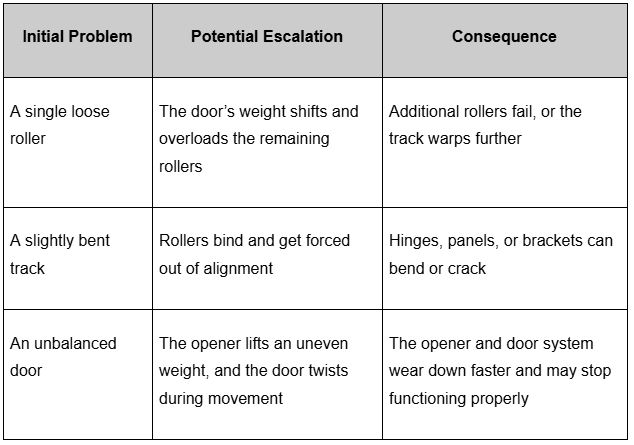
Along with safety concerns, a garage door off track can place abnormal stress on the entire system, which is how damage spreads beyond the original problem. When the door is no longer balanced, the tracks and rollers take uneven pressure, and the door panels can twist or strain as they move in a crooked path. Over time, that strain can deform parts that were designed to carry weight evenly, leaving the door harder to control and more likely to fail again.
The longer the door remains off track, the more likely it is that secondary damage develops, since the system is forced to operate outside its intended alignment. Rollers can wear unevenly, tracks may bend further, and the opener can struggle as it tries to lift a door that is no longer traveling cleanly. Because off-track issues rarely stay isolated, arranging emergency garage door repairs as soon as the problem appears helps prevent the situation from escalating into broader system failure.
What to Know After a Garage Door Off-Track Incident
When you notice a garage door off track, the situation calls for caution first, because the door is no longer moving the way it was designed to. The safest move is to stop using the door right away, whether that means avoiding the opener or resisting the urge to lift it by hand. Since an out-of-balance door can shift unexpectedly, continuing to operate it often worsens the misalignment and may cause additional damage while the system is already unstable.
After use has stopped, the opener should be disabled so the door cannot be activated accidentally, especially by someone unaware of the problem. Once the area is safe, the next step is to reach out for professional support, because trained technicians have the equipment and experience to diagnose what caused the derailment and restore the system correctly. Understanding what matters most in the first moments after a door goes off track helps prevent injuries and limits how far the damage spreads.
If you are dealing with a door that failed without warning and want to understand why fast action matters, check out “Garage Door Off-Track Service Near Me For Sudden Track Failures.”
Immediate Safety Concerns With a Garage Door Off Track
Safety becomes the priority as soon as an overhead door comes off track, since its full weight may no longer be properly supported. Clear the area around the opening and keep family members, pets, and vehicles away from the door, because an unstable door can drop or shift without warning when the track is no longer guiding it evenly. Treating the space as hazardous is important, especially while the door remains partially supported on one side.
The automatic opener should also be disengaged so the door cannot be moved by remote or wall control, since powered operation can pull the door harder against a damaged track and increase the chance of a sudden failure. Even after the opener is disconnected, the door should not be handled manually, because its movement may be uneven and difficult to predict while it is off track, and forcing it can worsen damage to the point where garage door replacement becomes the only safe option.
Key safety priorities include:
- Stop all operations, avoiding both remote and wall controls.
- Keep the opener disengaged, so the system cannot be activated by mistake.
- Maintain a clear safety zone, preventing anyone from standing near or under the door.
- Observe only from a distance, noting visible damage without approaching the door.
Why Trying to Fix a Garage Door Off Track Can Increase Risk
It can be tempting to treat a garage door off track as a simple adjustment, especially when the problem looks small at first glance. In reality, the door’s weight and the tension running through the springs and cables make this one of the more hazardous garage door failures, because a single misstep can cause the door to drop or the hardware to react forcefully. Without the right tools and training, attempts to fix garage door off-track issues often create more damage than they solve, while putting anyone nearby at real risk.
Correcting the alignment also depends on identifying the underlying cause, since a door that is reset without addressing what pushed it off track will typically derail again. A professional can evaluate the rollers, tracks, springs, and lift system as a whole, then restore balance in a way that keeps the door stable during future operation, while also flagging whether deeper issues point toward the need for future garage door installation if the system is too compromised to remain reliable. When a repair is attempted without that full-picture approach, the door may return to service in a weakened state, which can lead to repeat failure and a higher likelihood of sudden breakdowns later on.
Why DIY attempts usually increase risk:
- High-tension components can react suddenly, especially springs and cables under load.
- The door’s weight is hard to control off track, making slips or drops more likely.
- Hidden damage is easy to miss, so the door may derail again even after it seems “back in place.”
- Improper realignment can strain the system, accelerating wear across rollers, tracks, and the opener.
When to Seek Garage Door Off-Track Service Near Me
Knowing how serious an off-track door can be matters, but recognizing when to bring in help matters just as much, especially once the problem goes beyond a brief disruption. When the door starts looking uneven, catches while moving, or shows rollers that are no longer seated in the track, it is time to seek garage door off-track service rather than waiting for the issue to resolve on its own. Off-track problems rarely correct themselves, and continued use usually pushes the system further out of alignment, which increases both risk and damage.
Professional garage door off-track repair is the safest way to restore stability, because the system is heavy and under tension, which can turn small mistakes into major failures. A trained technician can pinpoint what caused the derailment, whether it stems from a simple track shift or a deeper mechanical issue, and correct it without putting anyone at risk. By leaning on expert service once warning signs appear, you protect the door, garage door openers, and the people who use that space every day.
Cases That Require Garage Door Off-Track Repair by a Professional
Some off-track situations are too unsafe or complex to handle without specialized experience, particularly when multiple components are involved or the door is no longer supported evenly. If the derailment connects to high-tension parts such as springs or cables, the danger rises sharply because stored force can release without warning when those parts fail. As noted by AirTAP in its hangar door safety guidance, heavy overhead doors become hazardous when they move unevenly or when cables and tensioned hardware show wear, which mirrors the risks seen in residential garage doors that slip off track. The same urgency applies when tracks are visibly warped or the door keeps slipping out of place, since repeated derailments usually point to an underlying mechanical problem that requires full system correction before safe operation can resume.
You should always call a professional when any of these conditions are present:
- The door is significantly off track or visibly distorted, especially if it hangs unevenly or looks unstable.
- A spring appears broken or compromised, since spring failure often triggers derailment and involves dangerous tension.
- Tracks are bent, loose, or pulling away from the wall, because the door cannot travel safely without a solid guide.
- The door repeatedly comes off track, which signals a persistent issue that will continue until properly repaired.
- Cables look frayed, snapped, or displaced, as cable problems affect balance and can lead to sudden door movement.
Why Professional Fix Garage Door Off-Track Options Are Safer
Choosing a trained technician for a garage door off-track problem is the safest path, because the door’s weight and built-in tension require careful handling to prevent sudden failures. Professional garage door off-track repair is more than putting rollers back in place, since the technician evaluates the full system to find what caused the derailment in the first place, checking tracks, rollers, springs, and cables so the door is restored to proper balance and alignment. With the right tools and a clear understanding of how every component works together, they restore the door to stable, reliable operation while reducing the risk of the same issue recurring, which is why expert service remains the smartest choice when safety and long-term performance matter.
Understanding the risks of a garage door off-track situation matters because safety and system damage often escalate faster than people expect. When you recognize the early warning signs and understand how derailments happen, you can respond before the problem grows into a bigger threat to your home and everyone around it. Calling an expert is important when the door is no longer aligned or stable, as trained technicians can safely correct the issue while addressing the underlying cause. By acting quickly and choosing professional support, you help restore dependable operation and keep your garage a secure, stress-free part of your day, especially when you reach out for garage door off-track service near me as soon as the problem shows up.
When you need dependable help with a garage door off track, Cleveland County Garage Doors is a trusted local team that understands how urgent these situations can be and how carefully they must be handled. Our technicians focus on restoring safe alignment, identifying the cause behind the derailment, and getting your door back to reliable operation without unnecessary delays. If your door is off track or showing warning signs, contact us today or give us a call to schedule service and get your garage door working safely again.
Frequently Asked Questions
Is it dangerous to try to fix garage door off-track issues on your own?
Trying to fix a garage door that is off track on your own is risky because the door is heavy and the system relies on parts that hold intense tension. Springs, cables, and rollers are designed to work under controlled alignment, and when that alignment fails, the door can shift or drop without warning. Injuries and added damage become far more likely when the system is handled without proper training, which is why this type of repair is safest in professional hands.
What damage can a garage door off-track problem cause if left unresolved?
Leaving a garage door off track unresolved allows the misalignment to spread stress through the entire system, which can turn a small derailment into a larger breakdown. As the door continues to sit unevenly, tracks can warp further, rollers may wear or fail, and panels can bend under uneven weight. The opener is also forced to work harder against a door that no longer moves cleanly, so delays often lead to broader damage and greater disruption than the original issue caused.
How can you tell when garage door off-track repair is necessary?
Garage door off-track repair is usually necessary when the door begins to move unevenly or no longer travels smoothly along both sides. A door that looks crooked while opening or closing, shakes during movement, or leaves visible gaps between rollers and tracks is showing clear signs of misalignment. Grinding, scraping, or popping sounds often follow as the rollers struggle to stay guided, and when the door hesitates, stalls, or fails to close completely, it often means the track system is no longer supporting safe operation.
Why did my garage door's off-track situation happen in the first place?
A garage door can go off track when something interrupts the alignment that keeps the rollers seated inside the tracks. Sudden impact, worn rollers, loosened hardware, or track damage can all shift the door’s path until the rollers slip out. Because the door depends on precise balance across both sides, even gradual wear can build up into a situation where the system can no longer guide the door correctly, especially after years of daily use.
What causes a garage door off-track issue to keep happening repeatedly?
When a garage door keeps coming off track, it usually signals a deeper issue that has not been fully resolved, since the tracks, rollers, and supporting hardware are meant to work in precise alignment as a single system. As explained by Wikipedia, a garage door depends on guided rollers and stable tracks to move correctly, which is why even a slight shift in alignment or gradual wear in the rollers can trigger repeated derailments over time. Because these components share the load every time the door opens or closes, recurring off-track problems tend to continue whenever the underlying cause remains in place, even if the door seems stable for a short while.
Why do rollers come loose during a garage door off-track problem?
Rollers come loose during a garage door off-track problem when the track path is no longer smooth or secure enough to hold them in place. A bent section of track, a loosened bracket, or a worn hinge can create just enough space for a roller to slip out under the door’s weight. Once one roller loses its seat, the door’s balance shifts, and that uneven pressure can pull additional rollers out as the system destabilizes.
How does a garage door's off-track condition develop during normal use?
A garage door off-track condition can develop gradually through normal use as parts wear down and alignment becomes less reliable over time. With thousands of open-and-close cycles, rollers can lose smooth movement, tracks can shift slightly, and hardware can weaken, which makes derailment more likely even without a sudden event. What starts as a subtle imbalance can progress until the rollers can no longer stay guided, especially when daily operation continues on a system that is already under strain.
Is it safe to keep using a garage door that’s even slightly off track?
Using a garage door that is even slightly off track is not safe, because the door is no longer traveling in a stable and supported line. Continued operation increases the risk of a sudden shift or collapse while placing additional stress on rollers, tracks, and the opener. Since off-track issues tend to worsen with use rather than improve, stopping operation and seeking professional help is the safest way to prevent injury and further damage.
What warning signs suggest you may need garage door off-track repair soon?
Warning signs often appear before the door fully derails, especially in the way it moves and sounds during operation. A door that looks uneven, vibrates, or struggles to travel smoothly along one side is often starting to lose proper track guidance. Unusual noises like scraping or grinding, visible gaps between rollers and tracks, or a door that hesitates or fails to close cleanly all suggest that garage door off-track repair may be needed soon.
When should you look for garage door off-track service near me instead of waiting?
You should look for garage door off-track service as soon as the door shows clear misalignment, becomes stuck, or stops moving smoothly, because waiting rarely improves the situation. Off-track doors can become more unstable over time, increasing both safety risk and system damage with every attempt to use them. Acting quickly protects the door, the opener, and the people around it, especially when professional repair can restore safe operation before the issue escalates.