
Most homeowners do not think about their garage door springs until something goes wrong. The reality is that a torsion spring rarely breaks without giving a few hints first. If you know what to look for, you can catch the problem early, protect your opener and cables, and avoid getting stuck needing broken garage door spring repair at the worst possible time.
This guide covers the most common warning signs that a residential torsion spring is nearing the end of its life. If you live in or around Lawndale, NC, this is especially worth reading. The Piedmont region sees real swings in temperature and humidity throughout the year, and those conditions quietly speed up spring wear more than most homeowners realize.
Your Garage Door Feels Heavier Than Usual
One of the earliest signs that a torsion spring is losing strength is a door that suddenly feels harder to lift by hand, or an opener that strains just to get the door moving.
Torsion springs carry most of the door’s weight. They store energy as the door closes and release it when the door opens. When the spring wears down, the opener has to compensate by working much harder than it was built to handle regularly.
What to check:
- Disconnect the opener and lift the door manually. A balanced door should rise smoothly and stay in place at about waist height. If it feels heavy or drops back down, the spring tension is off.
- Listen for grinding or labored sounds from the opener motor during operation.
Tip: Do not keep forcing the opener to lift a door with a weak spring. The extra load shortens the motor’s life over time. If the door consistently feels heavy or the opener is struggling, it is time to schedule garage door repair service before the problem gets worse.
For a closer look at what this situation looks like at home, read What Happens When a Garage Door Spring Snaps at Home.
The Door Opens Unevenly or Looks Crooked
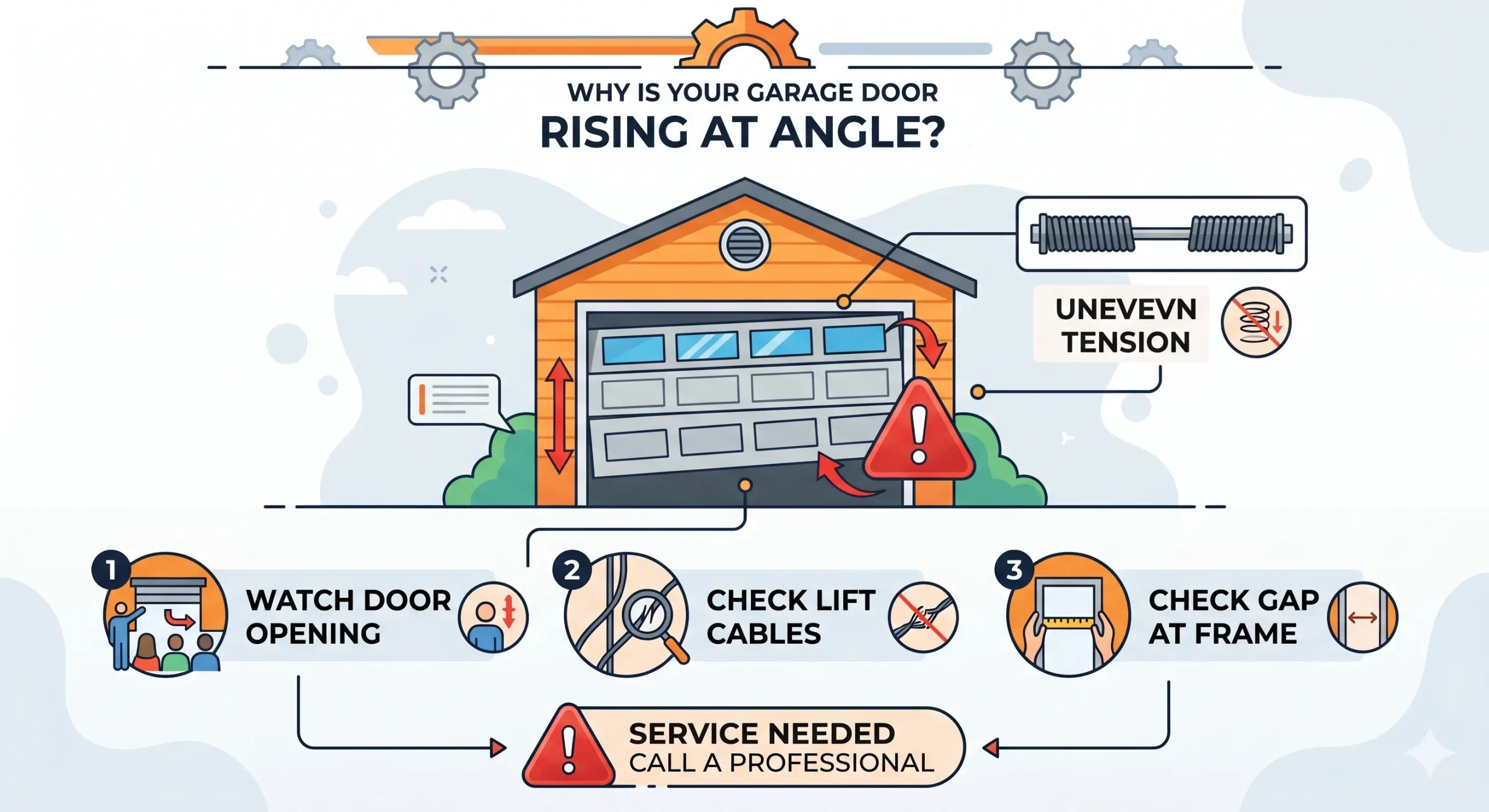
If your garage door rises at an angle with one side higher than the other, that is a mechanical warning, not a cosmetic one.
Most residential doors use a single torsion spring mounted horizontally above the door. When that spring begins to fail unevenly, the tension distribution shifts and the door tilts instead of rising straight. That misalignment adds stress to the tracks, rollers, and panels with every use.
What to check:
- Watch the door from outside as it opens. Does one side lag behind the other?
- Inspect the lift cables on both sides for slack or fraying.
- With the door closed, check whether the gap between the door and the frame is even on both sides.
Tip: Catching an uneven door early usually means a simpler repair instead of replacing damaged tracks or rollers later.
You Hear a Loud Bang or Unusual Sounds From the Garage
A sudden, sharp bang from your garage, especially when no one has touched the door, is a strong indicator that a torsion spring has snapped. The sound comes from the stored tension releasing all at once when the coil breaks.
Before a full break, you may notice smaller warning sounds. Creaking, clicking, or popping as the door moves can signal that the spring is under uneven stress or that the coils are starting to separate.
What to check:
- Operate the door a few times and listen carefully through the full cycle.
- Sounds coming from the top center of the door, near the spring shaft, are worth reporting to a technician.
- Light squeaking often just means the spring needs lubrication. A sharp pop or crack is a different kind of warning.
Tip: Apply a silicone-based lubricant to the coils a few times a year. Do not apply it if the spring shows visible cracks or separation.
There Is a Visible Gap in the Spring Coils
A visible gap or separation in the torsion spring coils is one of the clearest signs of failure you will find. Once that gap forms, the spring can no longer function properly and needs to be replaced.
Torsion springs are wound tightly under high tension. As they age, the coils gradually lose structural integrity and can begin to separate, especially in sections that see the most stress during cycles.
What to check:
- With the door fully closed and the opener disconnected, inspect the spring from a safe distance. Never touch or try to adjust it.
- A healthy spring looks like a tightly wound coil with no visible spaces between the loops.
- Any gap, separation, or heavy rust along the coils means professional service is needed right away.
Tip: Never attempt to adjust, wind, or replace a torsion spring on your own. The stored tension is significant, and mishandling it without proper tools and training causes serious injuries.
To understand more about why springs reach this point, read Why Garage Door Torsion Springs Fail Sooner Than Expected.
For guidance on what professional maintenance and inspection involve, the Door and Access Systems Manufacturers Association outlines key safety practices at DASMA Safety Tips.
The Door Reverses Before Fully Opening
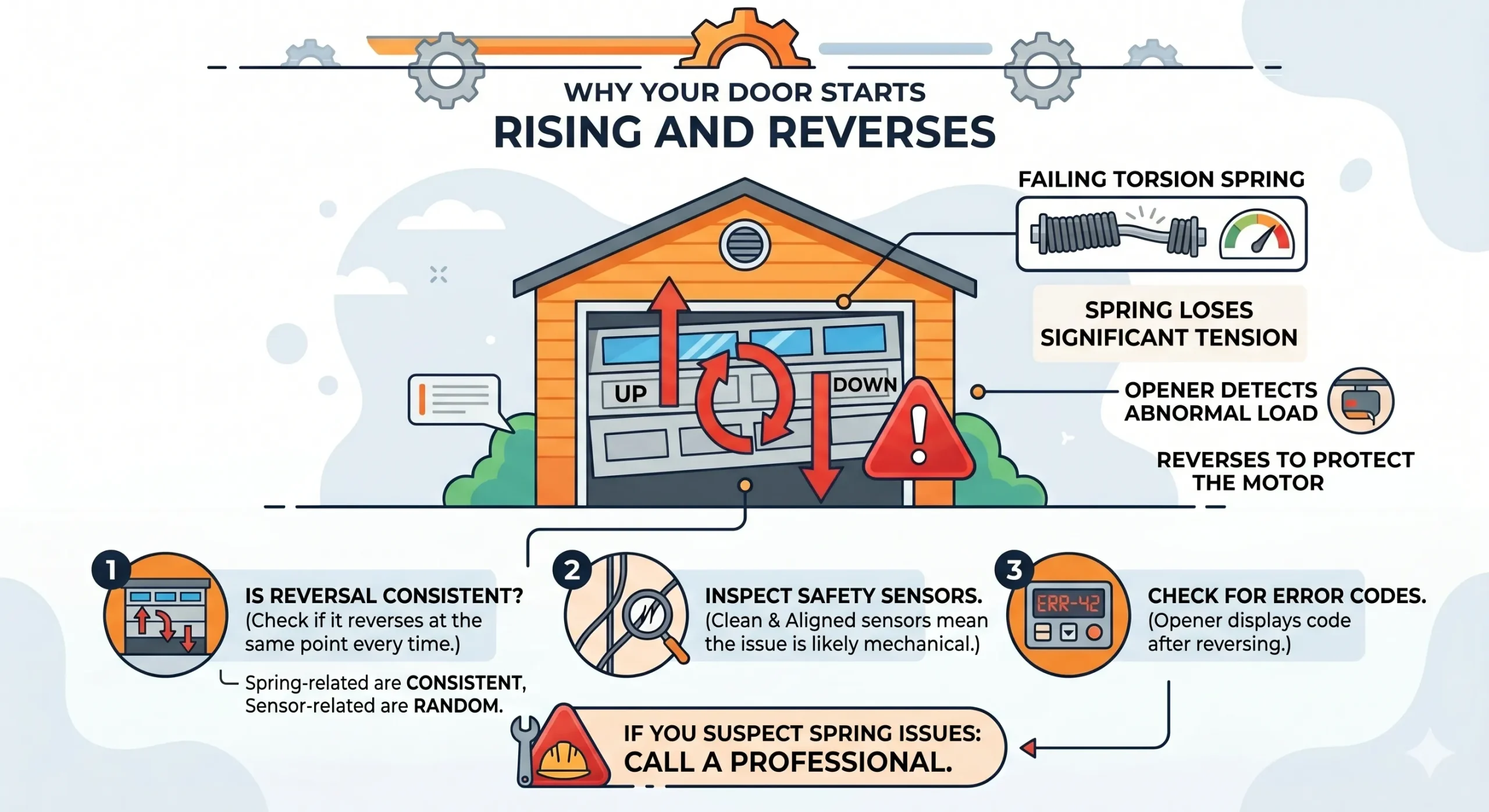
If your door starts rising and then reverses back down without completing the cycle, most homeowners blame the sensors. That may be true, but a failing torsion spring is another common cause.
When the spring loses significant tension, the opener’s resistance-detection system picks up the abnormal load and reverses the door to protect the motor.
What to check:
- Check if the reversal happens at the same point every time. Spring-related issues tend to be consistent, while sensor problems are more random.
- Inspect the safety sensors at the base of each track. If they are clean and aligned, the issue is likely mechanical.
- Check for any error codes the opener displays after reversing.
Tip: Do not keep retrying the door if it keeps reversing. Each attempt stresses both the motor and whatever tension remains in the spring.
For a broader look at common door behavior issues and what causes them, The Spruce’s guide to troubleshooting common garage door problems is a reliable reference.
The Door Falls Too Fast When Closing
A garage door should close slowly and steadily. If yours drops faster than normal or slams at the bottom, the torsion spring is likely no longer providing enough resistance to control the descent, which is a real safety concern.
What to check:
- Watch how the door closes from fully open to fully shut. It should take several seconds with a gentle landing.
- Disconnect the garage door opener and lower the door manually. A spring with healthy tension should still slow the descent without the opener.
- Check the cables for slack or fraying, as loose cables combined with a weak spring make a fast drop more likely.
Tip: A door that slams shut should be taken out of service until a technician inspects it.
The Opener Runs but the Door Does Not Move
When you press the remote and the motor runs but the door stays completely still, a broken torsion spring is one of the most common explanations.
Once a spring breaks, the full weight of the door falls on the opener alone. Most residential openers cannot generate enough force to lift that load unassisted, so the motor runs and nothing happens.
What to check:
- Pull the emergency release cord and try lifting the door manually. If it feels extremely heavy or will not budge, the spring has likely broken.
- Inspect the spring above the door for a visible gap or break.
- Do not keep running the opener. Repeated attempts against a broken spring can damage or burn out the motor.
You Notice Rust or Corrosion on the Spring
Rust is not just a surface issue on a torsion spring. Corrosion weakens the metal coils from the inside out, reduces flexibility, and increases the risk of a sudden break. In Lawndale, NC, where summer humidity and seasonal rain are a consistent part of life, checking for rust is a habit worth building.
What to check:
- Look along the full length of the coils for orange or brown discoloration. Light surface rust can often be managed with lubrication, but heavy corrosion or flaking means replacement is due.
- A rusty spring often sounds stiffer or rougher during operation. Increased resistance alongside visible rust is a strong warning sign.
Tip: A silicone or lithium-based spray applied to the spring two to three times a year slows rust buildup and extends spring life.
The Spring Has Reached Its Cycle Limit
Every torsion spring is rated for a set number of open-and-close cycles before the metal begins to fatigue. A standard spring handles around 10,000 cycles, which is roughly 7 to 10 years for a household using the door four times a day. High-cycle springs last significantly longer.
Many homes are still running the original springs that came with the door system. If yours has been in place for a decade or more with no service history, the spring may already be past its rated limit.
What to check:
- Consider the age of your garage door system. The past 10 years with no spring replacement is worth a professional check.
- High-traffic households can exhaust a standard spring in four to five years. Think about how often your door is used daily.
Tip: Upgrading to a high-cycle spring at replacement time costs a bit more upfront but reduces how often this issue comes up.
To know exactly when it makes sense to bring in a professional, read When to Call a Pro for Your Garage Door Torsion Spring.
The Door Works Fine One Day and Stops the Next
Not every spring failure comes with obvious warnings. Some homeowners are genuinely caught off guard when a door that seemed perfectly fine simply stops working.
A spring can operate at reduced capacity for weeks before it finally breaks. The door keeps moving, the opener handles the extra load without anything alarming happening, and then one day it does not open at all.
What to check:
- If the door stopped working with no prior symptoms, check the spring before assuming the opener or remote is to blame.
- Inspect the spring above the door for a visible gap or break.
- Think back over recent weeks. A slightly noisier or slower door may make more sense in hindsight.
Tip: A professional inspection every one to two years is the simplest way to catch a spring that is quietly wearing down before it fails completely.
Quick Reference: Warning Signs at a Glance
|
Warning Sign |
What It Likely Means |
|
The door feels heavy or hard to lift |
Spring losing tension |
|
The door opens at an angle |
Uneven spring wear or cable issue |
|
A loud bang from the garage |
Spring may have snapped |
|
Visible gap in the coils |
Spring is broken or failing |
|
Opener runs, door does not move |
Spring broken, the opener cannot lift alone |
|
The door drops or slams when closing |
Spring not controlling descent |
|
The door reverses before fully opening |
Opener detecting abnormal load |
|
Rust or corrosion on the coils |
Structural weakness developing |
|
Creaking or popping sounds |
Stress is building in the spring |
|
The door worked fine, then suddenly stopped |
Spring failed without warning |
Act Before It Becomes an Emergency
Catching a failing torsion spring early gives you time to schedule a repair on your terms and protect the rest of your door system from extra wear. The warning signs in this guide are common, and most of them show up well before a spring reaches a full break.
Homeowners in Lawndale, NC, and across Cleveland County can count on Cleveland County Garage Doors for professional torsion spring inspections and reliable repairs. If any of these warning signs sound familiar, contact us or give us a call today before a worn spring turns into a bigger problem.